Claim Evidence Reasoning Activity
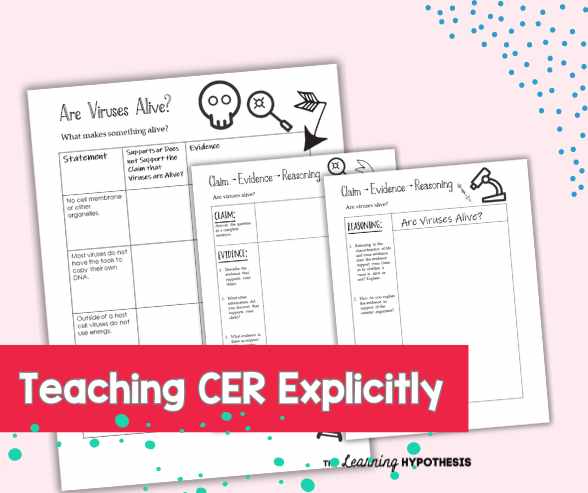
Ever wondered how we can make science class not just about memorizing heaps of facts but actually thinking like real scientists? That’s where teaching the Claim, Evidence, Reasoning (CER) framework seriously shines. I start the year with CER over the characteristics of life. What is claim evidence reasoning? It is a critical thinking tool. I think it is easy to see what we are doing by reviewing a claim evidence reasoning activity. This one is on viruses.
Grab the welcome pack to check out a Claim Evidence Reasoning Activity
Why do we need to teach Claim Evidence Reasoning?
It’s all about making bold claims, backing them up with solid evidence, and tying it all together with clear-cut reasoning. Here’s why explicitly teaching this method is super cool for students.
1. Cranks Up Critical Thinking:
Forget just soaking up info; CER gets students actively involved. There is nothing teens and tweens like to do more than debate. They also tend to be very black and white thinkers. CER helps them evaluate nuance. They learn to question things, form their own opinions, and defend them with actual data. It’s like training to become a mini-scientist, where questioning and proving are part of the daily grind.
2. Keeps It Real:
By diving into CER, students get a crash course in scientific literacy. This means they aren’t quite as susceptible to believing everything they read. They figure out how real scientists draw conclusions from experiments, not just in textbooks but in real-world issues too. It’s a skill that’s golden in today’s world where not every piece of “science” you read online is legit.
3. Boosts Those Communication Skills:
In a world where some people say using punctuation is agressive – communication skills are essential. CER isn’t just about what you think; it’s about how you express it. Students learn to organize their thoughts and present them in a way that makes sense. This means better writing, better presentations, and even better arguments at home about why they need that new phone!
4. Fosters Independence:
They learn to connect the dots. Independent critical thinkers are a boost to society. This approach teaches students to trust their own brain, not just what they’re told. They learn to look for evidence and use it to support their ideas, which turns them into more confident, self-sufficient learners.
5. Links Classroom to Real Life:
I know we all get asked, when will I ever need to know this? CER connects the dots between dry textbook theories and actual, hands-on science. When students use CER in experiments, they see how what they’re learning applies outside the classroom, which can make the whole idea of “science” a lot more exciting and meaningful. They also can’t resist a good competition and students love to “prove” they are right. You will be using “show me the evidence” as a refrain – in the best way possible.

Claim Evidence Reasoning Example
If you ask students, they will tell you that viruses are alive. In fact, during the pandemic mainstream would often talk about what it would take to kill the virus. Then you explain that whether viruses are living or not is highly contested in the scientific community. This usually piques their interest.
In this example I provide students with a brief overview of the characteristics of life. This is a topic that a lot of students roll their eyes about because it is boring. You might even get a few “Duhs” or whatever new Gen Alpha equivalent is coming.
Are viruses alive?
Students are given four pieces of evidence and asked to make a claim about whether viruses are alive, use evidence to support their claim, and describe their reasoning (how the evidence supports the claim).

I like to explicitly teach this which is why I use a claim evidence reasoning activity. I actually have a few more around this topic featuring zombies and monsters.
Claim Evidence Reasoning Rubric
I like to provide a rubric to help them evaluate each other’s work. In my zombie activity, students are provided a CER sample from a “student” and use the rubric to evaluate it before creating their own.
This is what the rubric looks like:
So, teaching CER isn’t just adding another layer to science class; it’s giving students the tools to think, analyze, and communicate like scientists. It makes the subject more dynamic, interactive, and, let’s be honest, a whole lot more fun.