
Oh Deer Game for the classroom.
One of the NGSS standards (and most state’s even if they aren’t NGSS) has to do with population size, carrying capacity, and limiting factors. I have always used some version of the Oh Deer Game, since I student taught over 20 years ago. However, it looks a lot different than it looked back then.
Scroll down to download the lesson and teacher’s guide.
Learning Standards:
NGSS HS-LS2-1 Use mathematical and/or computational representations to support explanations of factors that affect carrying capacity of ecosystems at different scales.
NGSS HS-LS2-2 Use mathematical representations to support and revise explanations based on evidence about factors affecting biodiversity and populations in ecosystems of different scales.
My Experience with the UFC version of the Oh Deer! Game
My students have historically tried to make this game a contact sport or a way to get out their grievances. Thus resulting in some injury no matter how minor. Sometimes getting students outside can be a challenge. So I switch things up, use the principles of the Oh Deer Science Game and let kids move without anyone getting a sprained ankle or torn ACL (at least that is the goal).
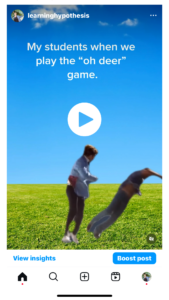
Traditional approach to the Oh Deer Game
In the traditional approach, you go outside to an open space. You divide the students in half and have them turn around with back to each other and take 20-30 steps away from each other. Each student is a deer looking for a resource.
Next, students will pick a resource. The resource is shown as a hand gesture. We usually do a triangle above the head for shelter, a hand over the mouth for water, a hand or triangle in front of the abdomen for food.
This is where it can start getting more like Lord of Flies than a simple science lab. Next, have the students turn around and find another student with the matching resource. If you find a match, you survive. If you don’t find a match, you don’t survive. Biology is not supposed to be a contact sport!
You can imaging how this cute Oh Deer! science game can become like a pro wrestling event or a rogue version of red rover.
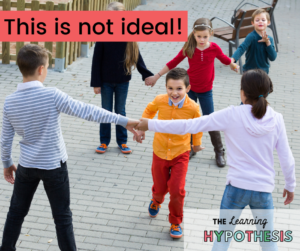
My approach to the Oh Deer Game
I like to use this game to not only show competition for resources, which I think most high schoolers have a good handle on, but also carrying capacity.
Don’t have time to piece this together?
Download this lesson now:
- Teaching Guide for the Oh Deer Game Lab Activity. (pdf)
- Student Sheet for the Oh Deer Game Lab Activity. (pptx)
Each student is given three colored squares. I start giving each person in class a deer. Each color represents one of the resources from earlier: food, shelter, water.
Sometimes, I have 1-2 students as additional spotters and one student taking data.
I start with all students with a deer standing. I have each student pick a resource from their squares and hold it up. At the same time, I randomly pull one of the colors from the cup.
If their color matches my color they stay standing and if not they sit down quickly and the spotters go around and collect the deer from the players now sitting down.
We have to add back in. We add deer back by adding 1 deer back for every 2 deer standing. The spotters will hand deer back out. The data collector writes down how many deer left in the population in that round.
Then we have another round.
Once the number of deer is below the carrying capacity, I start pulling two resources instead of one (the students continue to pick one). As long as they have one of the two they live and keep their deer. There is less competition and a better chance of survival.
I choose the carrying capacity based on the number of students in the room. Usually around half the students in the room. If the number of deer dips below that number, then you will pull two resources instead of one.
Utilize helper students:
Have the student recorder continue to record data once the deer have been added back following removal. The spotter(s) are collecting the deer that are exiting (deaths or emigration) and redistributing the deer (births or immigration) making sure things are running smoothly.
If you go above the carrying capacity again, then you would go back down to pulling 1 resource.
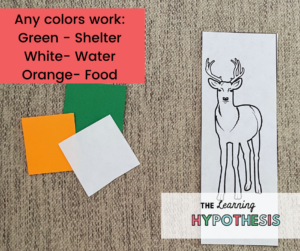
How my version of the game looks in action.
If I start with 30 students, I would choose about 2/3 to start out being deer (You could pick more or less). Each will have 3 resources and then 2/3 have a deer (sometimes I print the deer and sometimes it is an extra sheet of paper). So there would be 10 with deer.
I pick 1-2 spotters and a recorder. These people should not be deer or have resources. I am the caller and pulling resources for each round. For this example, I’ll use 2 spotters and a recorder. I would divide the class in half and assign a half to each spotter.
I try to close my eyes and randomly pick a resource. You can also use beads that match the color of the resource paper squares.
Everyone with a deer stands at the beginning.
For this example, the recorder starts with 20 deer in population and zero removed from population. I like to remind students that deer will leave the population by dying or by simply leaving (emigration) to look for an area with more abundant resources/ less competition. A deer exits when the resource it picks doesn’t match my resource(s).
Starting Data: 20 deer in population. Zero removed.
After round 1, 12 students lose their deer. The spotters collect the deer. Now add back 1 deer for each deer left standing. There are 8 deer standing so this would be 4 deer. The spotters pick the students that now become deer. They should pick students that weren’t deer previously and try to continue to rotate where everyone gets to a be a deer. The recorder writes down the information from the round.
12 deer in population. 8 deer have been removed.
In this example 1/2 of the students in the room is the carrying capacity, which would be 15. So when the number dips to 1/2 or below I will make a slight change. Because there is less competition, the next round I will pick two resources. We only lose 2 deer. Spotters collect the deer. We would add 5 deer back with spotters redistributing. Recorder records new numbers.
15 deer in population. 5 removed.
We are back about 1/2 of the total class which was the predetermined carrying capacity, so I would go back to picking one resource. We lose 7 deer. The spotters collect the deer exiting. Now add back 1 deer for each deer left standing (4 deer). The spotters pick the students that now become deer. The recorder writes down the information from the round.
12 deer in population. 8 removed.
Go back to picking two resources.
I like to do enough rounds to clearly display the carrying capacity.
Why this works for me
- We aren’t having full contact sport vibes going on. No injuries=a better day.
- They get to experience what carrying capacity looks like versus just describing.
- It provides data for our mathematical modeling graph.
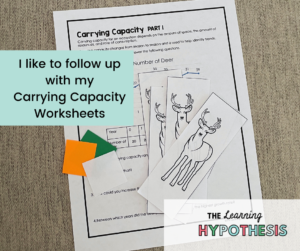
Closing out the Oh Deer Game
Have your spotters collect everything and get it ready for the next group. Pass out some graphing paper. We walk through graphing the data and interpreting the graphs.
This is one lesson in my lesson pack on carrying capacity and unit on population ecology.
Looking for more?


