Nonfiction Reading Strategies: Questions
Last week I discussed activating background knowledge. This week we are moving on to the next strategy in nonfiction reading. The next strategy is questioning. This is not a strategy that is specific to nonfiction texts, but it does have some variations that are specific to assist nonfiction readers. Questioning strategies involve metagcognition. Metacognition is just “thinking about thinking”. Research tells us that learners do better with explicit teaching of these strategies.According to Dymock and Nicholson, the nonfiction reading questioning strategy can be divided up into three categories:
“right there”, “think and search” , and “beyond the text”.
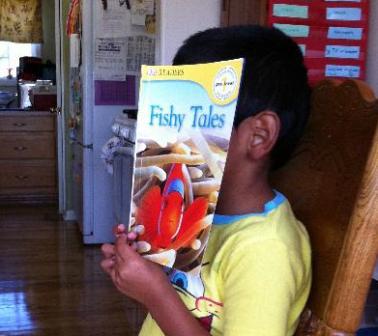
Examples of the three question types with some examples using the book Fishy Tales.

“right there”- What are the facts?
For example, in Fishy Tales, begin by helping them take an inventory of the material they learned from the text. You can use an OWL or KWL chart to help make this point. These types of charts are helpful in activating background knowledge.

“think and search”- What does the writer want me to learn from this text?
This is where thinking outloud and modeling helps your students. You might say, “I learned that the word sway is a funny word. Is that what the writer wanted me to learn? Why did the writer write this? What did they want me to learn?” In Fishy Tales, the focus of the book is a ocean life surrounding a coral reef and examples of animal behavior.
“beyond the text”- What is left out? What do I need to find out to understand this better? What could help me make this make more sense?
This is really hard for students and they may need a lot of guidance from you. In the example Fishy Tales, it might be helpful to find out a little more about coral reefs and coral reef food chains. I think of this as taking those big why questions and breaking them down into manageable chunks. If the students wants to know why the shark ate the fish, what information would help him determine the answer. Why questions are great, but students don’t need to stop with why. They need to create a plan to find out the answer.

Now as I mentioned at the end of last week, my little guys are great at asking questions. They are not always sophisticated questions. Questioning grows as your child develops. Encourage questions as much as you can stand. This is such an important skill and active strategy for for later success. Questions aren’t just in one of these three categories. Good readers also ask questions that help them activate the background knowledge we were talking about last time and questions that help them analyze text structure.
I am using a great article from The Reading Teacher as my primary reference for this series. Check it out.
Dymock, S. a. (2010). “High 5!” Strategies to Enhance Comprehension of Expository Texts. The Reading Teacher , 166-178.
Disclaimer: I am an Amazon affiliate