Population Ecology Activities
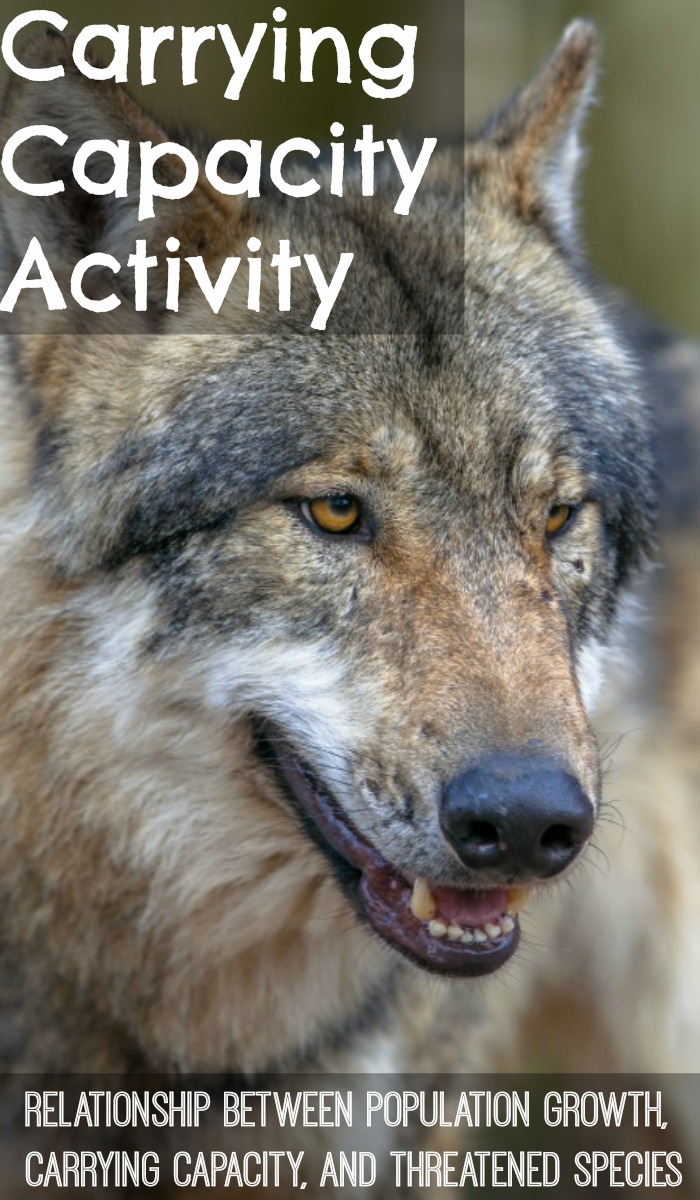
Ecology can be a difficult topic to support student connections. Using population ecology activities like a carrying capacity game, a carrying capacity activity, and making connections to African elephants and Gray wolves are great ways to foster interest.
Nothing is ever as simple as we would like to think it is. Protecting species from overhunting or poaching is a good start, but not the entire solution. Many species have not benefitted from their relationship with humans. Human interaction with our environment (far beyond direct hunting of a species) alters carrying capacity and population growth. Ultimately impacting the total numbers of species left. Using a carrying capacity activity to teach this complicated topic makes it more approachable for students.
What are population ecology activities?
Let’s start with carrying capacity. The carrying capacity of an ecosystem is the amount of biomass that a specific habitat can support. The habitat can be as small as a drop of water or as large as the entire planet. The idea is that there is a finite amount of abiotic and biotic factors available to any given system. The carrying capacity is the number of all species or a specific species in an ecosystem when population growth remains relatively constant. There is a lot of overlap between population ecology and evolution. If you are looking for ideas for your evolution unit, check out my natural selection lab post.
Typically you will see carrying capacity illustrated in a line graph that looks something like this

The carrying capacity is where the population growth seems to stabilize. Indicated by a straight yellow line below.

Use a Carrying Capacity Game
I prefer hands-on learning. If you have a large space, I suggest doing the Oh Deer Game outside or in large space where the kids can run. If you don’t have a large group, you can follow this card game adaptation. As a result, students will quickly see that competition for resources impacts how many deer (or other species are in a single population).
Follow up with a Carrying Capacity Activity.
Follow up the game with an activity where kids can use their new knowledge of carrying capacity. Kids will analyze graphs and data to determine the carrying capacity for deer (and other species) in a small wildlife reserve.
In this carrying capacity worksheet (pdf), students can predict how human interaction could change the carrying capacity. Examine the trophic levels of the system and predict how each species may impact the other. Great addition to a larger ecology project as homework or in a small group.

What is population growth?
Population growth is the number of new organisms (through sexual and asexual reproduction) and the number of organisms that die during the same period. This gives the net population growth. If it is positive then the group is growing in numbers, but if it is negative the group is decreasing in numbers. The population growth reflects the carrying capacity.
This isn’t always negative, but these population growth curves are monitored closely by environmental scientists and conservation biologists. Therefore, we use population growth curves as one way to monitor and prevent more threatened species.
The general population curve looks like this familiar graph. This is the same graph that we see in the carrying capacity activity and carrying capacity worksheet.
There are typically two phases of population growth. In the first phase, there is exponential growth because it is not limited by the resources. Logistic growth (usually a S-shaped pattern) occurs in phase two because it will stabilize. The population will go up and down slightly as the result of the population reaching the maximum for the resources available.
In this graph, the exponential growth is circled in red and the logistic growth is in yellow.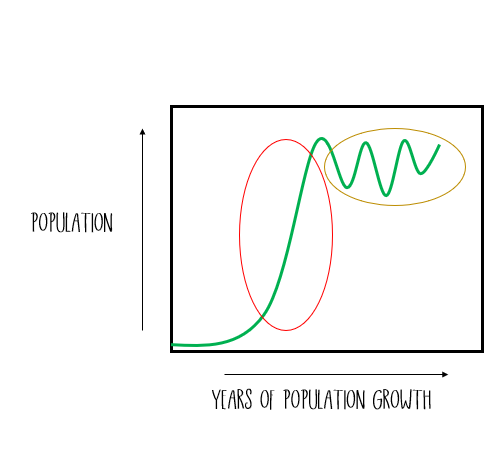
How does this relate to threatened species, like African elephants?

One of the biggest impacts that humans have on other species is habitat destruction. When species don’t have a place to live their numbers dwindle. Find out what conservation biologists are doing to help endangered and threatened species. Species in an ecosystem work together with each having a specific role so that a single change can impact the entire ecosystem.
Threatened species of African elephants are being impacted by habitat destruction and poaching. Therefore, understanding carrying capacity and population growth help scientists track these species and prevent extinction.
Carrying Capacity is crucial for conservation
It is imperative that we make understanding the critical relationships between space, resources, and population growth a topic that all students understand. Introducing threatened species like the African elephant and other species closer to home (like the work to save the American eagle) is a great way to make ecology meaningful. There are things that we can do to save species and understand that each species has a role in their ecosystem and the balance of nature (which humans are part of).
One of the ways to get kids excited is by presenting materials in a new way. Population growth is not just an animal issue. The idea that the earth has reached its carrying capacity for the human population has been debated for years.
Ecology isn’t just something that should be discussed in the classroom, but is crucial for the health of the planet and every species that lives here. Using interactive population ecology activities like a carrying capacity activity, carrying capacity game, and/or a threatened species like African elephants make it more interesting for students and easier for teachers to teach.
Make sure to check out or other teaching ideas for ecology units.