Anatomy & Physiology: Getting a Good Start.

Are you taking Anatomy & Physiology this year? Are your plans to be a nurse or other allied health professional? A&P can be a scary course for students.
I have taught this course for many years and see very successful students every semester. A&P is a manageable course, but there are lots of factors that are going to impact your success.
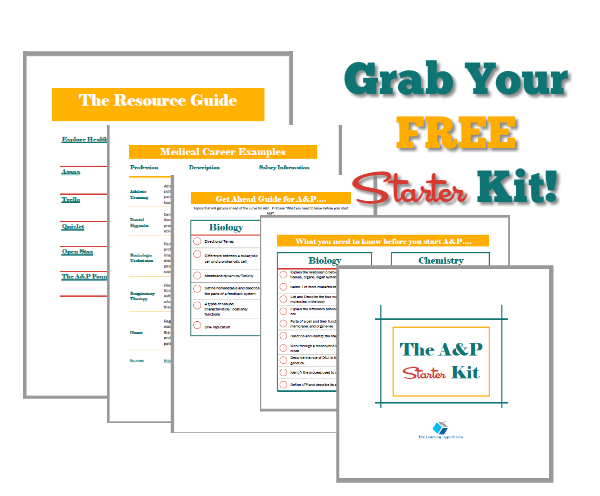
I have previously written about the 5 reasons students stumble in college biology courses. That was a generic list. This is five areas of concern for A&P students. This is about foundation. You need to be addressing these areas so that you can get a good start on your semester. You can grab a free starter kit for A&P by clicking the image below.
Getting a Good Start in Anatomy & Physiology
Time Management:

If you aren’t committing the time then none of the other stuff matters (for the majority of students – and as far as studying goes assume you are in the majority until you see you aren’t).
Anatomy & Physiology is a time intensive course. I would suggest budgeting 3+ hours in study for each hour in class or lab. The number one reason students sight for failure in online learning environments is time management issues. That also happens in the regular classroom environment.
Many students don’t understand that that will need to make some sacrifices for school. There is always a trade off when you are talking about time.
I have a mini course on time management that is completely free. Basically you need to align your goals and your priorities and then make a plan. Be realistic about the time in a day and your commitments.
Reading/Writing/Math Skills:
This may not apply to you, but I want to mention it. If you have scored on the ACT/SAT where you are taking developmental courses, I URGE you to complete those prerequisites before attempting your A&P course.
There is a lot of reading involved in A&P and as a science there are lots of explanations that involve math concepts.
Background Knowledge:

If you haven’t taken a biology course in the last six months, you might need a refresher. Textbook publishers have great resources to help jog your memory.
College professors assume that you have had high school level biology courses and hopefully chemistry. If you haven’t, you will often find yourself feeling a little overwhelmed in the beginning.
There simply isn’t time to teach from the ground up. If you don’t remember your basic biology terms and concepts, I suggest getting a prep book or using your textbook sources. There are great books on the market and lots of courses.
- A book that I like is Getting Ready for A&P by Pearson (it can be a little pricey). Access to the books’s site often comes with new (Pearson publishers) A&P textbook purchases. Most publishers have something similar.
- I offer a prep course. The A&P Foundation Session will prepare you for college level A&P. There is a self-paced course and live course option.
- If you go to your first lecture and feel behind or intimidated, get help immediately! I find that students have a tendency to get frustrated at the beginning of A&P I, because it doesn’t jump into body systems. A&P I will cover basic terms, chemistry, cells, and other basics before even starting to cover tissues
Study Skills:

Studying is very individual, but there is a common thread for the overwhelming majority of students. Studying needs to be an active process.
If you find yourself reading often without writing anything down, you aren’t doing it right. The truth is the more we re-read the less attention we give to the task which means the less benefit.
Re-writing the notes, making notecards, recording yourself going over the lesson are all active ways to study. Attempt to “teach” the material to a study partner. Get in a study group. GO TO LAB.
The following lists are a few specific strategies or suggestions. I will be posting some specific information on studying for A&P
-
Spend Time in Lab:
Typically there are some open study times in A&P lab. Spend time in the lab studying. Take your lecture materials and try to connect the lecture and lab materials. There is no substitute for spending time in the lab. Lab exams are going to be mastered via repetition. Just like when you were learning your body parts as a toddler.
-
Get a Study Group:
I suggest that study groups meet somewhere for a specific time and then plan to have coffee, dinner, or whatever after. This allows time for socialization and blowing off steam (and complaining about the course/instructor) that doesn’t cut into study time. I highly suggest that you establish ground rules about staying on task during study time. I have seen highly successful groups and groups that would say they were studying, but when you were walking by the group they were NEVER on topic.
-
Color Code EVERYTHING:
There are lots of examples on Pinterest, but don’t waste hours looking through other people’s systems. In reality you will probably need to create your own. Highlighters, colored pens, flags, sticky notes and even colored paper are all things to include in the color coding. I find if I use colored pens, then I can only highlight more important information. You might start by creating a vocabulary list and color code it by subject or type of information.
-
Sticky Notes and Other Supplies:
It might be college, but you still need school supplies. You can use poster boards or whiteboards to create large diagrams of information. (If you use a whiteboard, just take a picture). I discourage the use of tablets and laptops for notes. It is too easy to get distracted. It is also too easy to distract other students. If you are using technology, put a blocker up so that you can focus on your course. Using notecards/flashcards is a great way to study, but many students use this inefficiently. Don’t just copy your notes word for word on to flash cards, take the information and re-write it. Don’t just flip through the cards. Ask yourself questions and use the cards different ways. For instance, ask “which of the following” type questions and put cards in piles.
-
Reading the text:
Make sure that you are reading the text efficiently. Many students truly struggle with how to read non-fiction materials. If you are struggling, I suggest taking a little time to think about if you are reading in a way that retains the material? If not, you need to find out how. There are great resources online, but I would start with Pinterest.
-
Use the Tutoring/Learning Center:
Most colleges have a tutoring/learning center where tutoring is provided for free or greatly reduced prices. If you feel the least bit concerned, go and get signed up. Tutors are often people who have successfully completed the course very recently and can give you lots of great insight. Tutoring isn’t just for failing students.
Motivation:
You are the only one that can determine your motivation. If your goals aren’t motivating, you need a reassessment.
If you can’t figure out why you aren’t motivated, I suggest you take the free mini course I offer on Time Management for Students.
In that course, I discuss creating goals and priorities. Goal setting is a skill and many people need help with at first.
More Tips for A&P
- Be early
- Be prepared: Bring your syllabus and class schedule (if provided) to all class meetings. Sometimes instructors will make changes. The syllabus and class schedule are important and inherent to the course.
- Don’t ask if this material is important? All material is important, or they wouldn’t teach it.
- Don’t ask if class attendance is mandatory? You may ask if there is a grade associated with attendance. Do email the professor if you have a planned absence.
- Don’t ask for study guides on the first day or to see old exams. You might email the instructor later and explain that you are feeling overwhelmed by the amount of material. Tell them you want to make sure that you are using your time to the best of your ability, and ask if they have any study suggestions or if there will be a study guide to help prepare for the exams? You might also include that you know that they are busy, but if they have the time you would really appreciate their input. They are the expert on their course. The difference is that you are saying you know studying is YOUR responsibility and you are asking if they are willing to provide additional input. Sometimes it will be yes and sometimes no.
I hope that you are on the path to a great semester. I will be continuing to post tips and tricks for A&P and other courses. You can grab the A&P Starter Kit, by clicking on the image below.